Showing posts with label #walkmyworld. Show all posts

Tuesday, March 22, 2016

Digital Storytelling: Synthesizing My Multimodal Journey with #WalkMyWorld 2016

There is no greater agony than bearing an untold story inside you. – Maya Angelou

WEEK NINE: Collect and curate how you used different modes (i.e., images, text, video, and audio content) to reflect on your past, present, and future identities. This week, #WalkMyWorld invites you to produce a digital story that synthesizes your journey over the past eight learning events.

Digital storytelling weaves multiple media sources into a compelling narrative that moves beyond stating a sequence of events by inviting the audience to think about what they believe and challenges them to consider a different point of view. When you have time, watch Emily Bailin's 17 minute TED talk as she explains her research with the power of digital storytelling.


Notice how Emily Bailin starts with a question,"Where am I from?," and then applies the inquiry process to examine her life's journey as an educator, until the finished digital story has a captivating beginning, a compelling middle, and a convincing end. Using the same mentor poem, Where I’m From, by George Ella Lyon, I synthesize my digital story using three different mediums. How does your engagement with my story change when you engage through different mediums:
1. I used Storify to collect and curate a few tweets from each learning event, click HERE.
2. I used Google Docs, to write my poem using words, click HERE.
3. I used Animoto and Soundcloud to create my digital story, click below.

Invitation: COLLECT your multimodal content from the past eight learning events. CURATE your digital story using digital tools like Storify or Diigo Outliner. SHARE your creation on Twitter using the hashtag #WalkMyWorld #LE9. It’s time. What will you share? Explore.Play.Create.Learn.

Interested in learning more about #WalkMyWorld, visit: walkmy.world


Tuesday, February 9, 2016

Shape of a Story: #WalkMyWorld #LE3

When we own the story, we can write a brave new ending. - Brene Brown
WEEK THREE: Exploring the story of you by considering the shape of a story. Stories come in multiple modes: orally passed down from generation to generation, images capturing a specific time and place, documents representing written thoughts, and video clips revealing the sounds and motion of real people and events. The third learning event of #WalkMyWorld invites you to explore the multiple modes that shape the stories you tell the world.
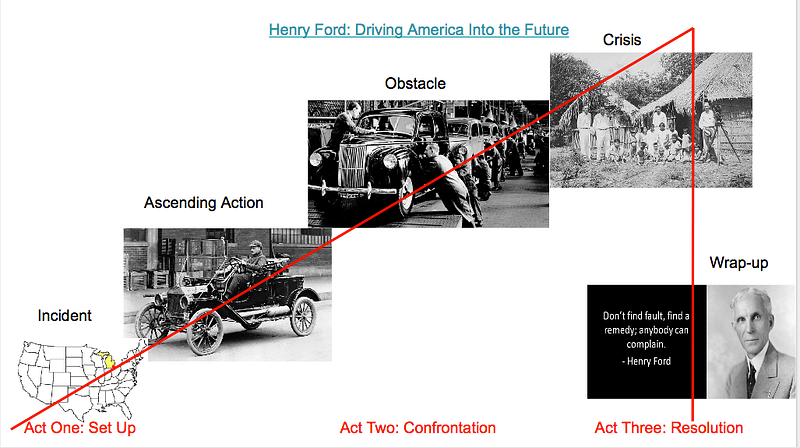
One way I integrate technology while meeting the academic demands of English Language Arts and social studies is through student-created documentaries. These short, two-to-seven minute films, combine multiple media sources with a voice-over narration to demonstrate an understanding of a subject-matter topic or personal event. Since quality documentaries use the THREE ACT STORY ARC (see image above), I decided to diagram the shape of an award winning story from the National History Day Competition.

This is a diagram of a student-created documentary about Henry Ford: Driving America Into the Future.

Notice how the obstacles Henry Ford encountered built the narrative and the multiple modes shaped the story. Next, WATCH the documentary and notice how the narrative is shaped by the author’s ability to weave multiple modes ( e.g., audio, visual, text, and transition effects) into a compelling story. Finally, READ the transcript of the documentary. Research suggests the use of video-editing software scaffolds an intentional revision process as students determine which media source(s) enhance their voice and shape a stronger narrative (Chisholm & Trent, 2013; Parker, 2013; Vasudevan et al., 2010). Do you agree? If your students are turning in boring reports, consider using student-created documentaries as an instructional approach to creating compelling narratives and shaping three act stories.

Invitation: THINK of a story you know well. This could be a cultural folk tale, a song, a TV show or the STORY OF YOU. CREATE a diagram showing the shape of that story. ANNOTATE your diagram to identify plot points at key events in the narrative. You can create this diagram in Google Slides…or simply sketch it out on paper and take a digital photo. DESCRIBE how your diagram and the modes (text, image, audio, video) used in the story affect the shape of the story. SHARE your creation on Twitter using the hashtag #WalkMyWorld #LE3. It’s time. What will you share? Explore.Play.Create.Learn.

Interested in learning more about #WalkMyWorld, visit: walkmy.world

Monday, January 11, 2016

#WalkMyWorld 2016: Past.Present.Future

The best part of #WalkMyWorld is the social scholarship (i.e., community, discussion, and reflection) that occurs. Although teachers talk all day to students, they rarely make the time to talk to colleagues. By keeping #WalkMyWorld open, others may stumble on our discussions and learn, grow, or even join in. If you want to read more about how I created my Personal Learning Network (PLN) from #WalkMyWorld, click HERE.

Should #WalkMyWorld remain open or move to private streaming? 
I keep thinking about where to post #WalkMyWorld information...this answer is vast. In the past, some participants created a new Twitter profile because they didn't want their followers to be a part of their class work or see their students' information. However, some participants didn't like having several different accounts and used the one they had already established. Finally, there were participants who didn't want to post, they wanted to keep everything on paper. So I guess the question is, "What is our purpose for #WalkMyWorld?" Is it to collect data for research, then we should set it up to make the data collection process easy. If our purpose is to teach others how to make meaning from multiple modes through an online learning environment, then we need to use the medium that people will easily share their thinking. Twitter is a platform that is becoming more accessible to educators and classrooms. To me, Twitter is still a valuable medium to share, explore, and play with multimodal meaning-making and digital tools.

As we reflect on the PAST #WalkMyWorld in order to plan for the PRESENT learning events and build a foundation for the FUTURE, I feel the picture below captures the answer. Let's stand in the middle by using Twitter, not only to collaborate and communicate, but to begin to show others about new digital tools like Medium.


How did you get involved in #WalkMyWorld? Did you start as a participant or facilitator? I started out as a participant because I was following Greg McVerry and Ian O'Bryne on Twitter after I met them at an LRA conference. Ian responded to one of my posts and I became more involved. By the end of Learning Event 10,  Ian invited me to help analyze his data. That analysis became a paper, “Social Scholars: Educators Digital Identity Construction in Open, Online Learning Environments," that we presented at the 2014 Literacy Research Association Annual Conference. The paper was recently published in Literacy Research: Theory, Method, and Practice, a peer-reviewed publication of the Literacy Research Association. 

How have you grown as a teacher because of #WalkMyWorld? Each day I participate in #WalkMyWorld, I become a more knowledgeable teacher:  1) technological knowledge - everyone shares new tools or aspects of a tool I didn't know I could use; 2) pedagogical knowledge - I read about how other teachers are creating and managing an online learning environments; 3) content knowledge - I have witnessed lesson plans for incorporating technology in science, social studies, math, and English Language Arts. These knowledge components are also known as technology, pedagogy, and content knowledge (TPACK; Koehler & Mishra, 2009) which provides a framework to understand the domains of knowledge educators should have for authentic technology integration.  
-->

How have your tech skills grown?
My engagement in #WalkMyWorld integrated my theoretical understanding of multimodal composition and my passion for poetry. The #WalkMyWorld community held me accountable for increasing my creativity. At the same time, #WalkMyWorld collaboration gave me support as I tried new techniques and technologies. For example, Kevin Hodgson's interactive poem inspired me to write an interactive poem about the sunrise. Even though Twine was easy to use as a multimodal composition tool, I struggled to embed the poem on the Internet. I used Twitter to contact Kevin for help and we spent several days collaboratively working to solve my technical issues. I also used Twitter to invite the #WalkMyWorld community to write a poem on Goggle Drive. This way I was still involved in the learning event but I shared the responsibility to write a full poem. I was so excited to see how the poem grew and changed as different authors added their voice.  Click HERE if you want to read or write more into the poem.

Interested in other discussions about the planning of #WalkMyWorld 2016? Check out the planning meetings on Google Hangout: Day 1, Day 2 or read the blog posts below:

Kate Booth
Greg McVerry
W. Ian O'Byrne
Carolina Orgnero 
Stephanie Loomis


Monday, February 2, 2015

#WalkMyWorld Learning Event #3: Struggling Doesn't Mean Stupid

Welcome to Learning Event Three in the #WalkMyWorld Project! For this learning event we invite you to reflect on your identity. Do you have one consistent identity (online and offline) or are they different? Does the identity you share publicly represent who you are inside your head?  The facilitators of #WalkMyWorld are challenging you to open up by sharing a piece of your past or your goals for the future. Today I felt like sharing a piece of my past with a picture of me in 5th grade, when I first realized my brain struggled with letters.

Present identity: This is me at an International Literacy Association conference (formally known as the International Reading Association) with my good friend and mentor, Dr. Jerry Johns. I am a third year PhD student, the president of Pennsylvania's Reading Association, and a leader in the field of literacy.


Past identity: This is me as a fifth grader (with my younger brothers). Despite the dimples and the feathered hair, this was the year I was anything but an average 5th grader. For the first time I realize my brain was always going to struggle to process letters when I had to walk down the hall to a 4th grade reading class. I loved school, but no matter how hard I tried, or the hours spent with tutors, my brain still struggled to spell simple words. I also struggled to recall subject-matter content for tests. As a result, I was placed in a lower academic track for middle and high school.

My guidance counselor said I shouldn't waste my time applying to college. My college accepted me on a one year probation after I pleaded in an entrance interview that:

I HAD to become a teacher so I could tell students who struggle with letters that they are brilliant.

I HAD to become a leader in literacy so I could show educators how to look beyond poor spelling.

I HAD to become a researcher so I could find evidence that struggling doesn't mean stupid.

Struggling just means I need more time to process letters. I need technology to spell my words, and I need multimodal opportunities to show my brilliance.

Take some time this week to think about who you are and share your reflections with me at the #WalkMyWorld Project. You can click this link to read more about Learning Event #3: http://wiobyrne.com/walkmyworld-learning-event-three-2015/

Happy reflecting,
Julie

Wednesday, March 5, 2014

Reader.Writer.Scholar: Reflections for #WalkMyWorld

Is poetry still relevant in a time when educators prepare students for high-stakes testing in school while students read and write on cell phones, iPads, and laptops out of school? I asked this question during my first semester in graduate school and used the findings to write a blog post for the International Reading Association’s TILE-SIG blog. As I reflect on my experience with the #WalkMyWorld project, I realize I was replicating my first study. Instead of examining the effects multimodal composition had on 5th grade students’ engagement with poetry, I was examining the effects multimodal composition had on ME. Here are my findings.

READER: My engagement in #WalkMyWorld began as a reader. As I scrolled through the Twitter feed, I selected poems by the media that provoked curiosity. I was amazed at the quality of poetry and found myself rereading poems with a critical eye to determine how the author crafted the text or used multiple modes to evoke emotion. In order to improve my ability to write, I used the author rather than the media as the criteria for selecting which poem to read. Eventually, I moved away from my night time routine of reading facebook posts to reading Twitter #WalkMyWorld posts.

WRITER: My engagement as a writer evolved from isolated poems to recursively generating a poem throughout the day. Initially, I took a picture, wrote a poem, posted it to #WalkMyWorld, and then crossed the task off my “to do list.” Now, a word might spark the need to take a picture or a picture might dictate the words. As my involvement in the project increases, I notice a greater sensitivity to the natural world and language that surrounds me. I learned the importance of taking a picture the instant nature sparks my attention. Thinking about my audience motivates me to go back and retake a picture in order to adjust the quality. In the beginning, I generated poems by selecting words from my own schema. Now I collect words and phrases throughout the day by typing them into the notes section in my cell phone. This recursive shift continues to improve the quality of my writing and enjoyment in the composition process.

SCHOLAR: My engagement as a scholar integrated my theoretical understanding of multimodal composition and my passion for poetry. The #WalkMyWorld community held me accountable for increasing my creativity. At the same time, #WalkMyWorld collaboration gave me support as I tried new techniques and technologies. For example, @dogtrax interactive poem inspired me to write an interactive poem about the sunrise. Even though Twine was easy to use as a multimodal composition tool, I struggled to embed the poem on the Internet. I used Twitter to contact @dogtrax for help and we spent several days collaboratively working to solve my technical issues. I also used Twitter to invite the #WalkMyWorld community to write a poem on Goggle Drive. This way I was still involved in the learning event but I shared the responsibility to write a full poem. I was so excited to see how the poem grew and changed as different authors added their voice.  Click HERE if you want to read or write more into the poem.

By breaking down barriers of creating, collaborating, and sharing multimodal poetry the #WalkMyWorld project aligned theory, research, and social media. Today is your chance to make poetry relevant by joining the #WalkMyWorld project. Share your thoughts on how the project enriched your experiences as a reader, writer, and scholar.


Monday, February 24, 2014

Exploring my Poetry Genius #walkmyworld

For me, poetry has always served as an emotional container (Fletcher, 2002). Whenever I feel angry, depressed, or frustrated, I pick up a pen and attack the paper until my emotions are spent. After #walkmyworld introduced me to PoetryGenius, a free website that allows readers to annotate and share poetry, I was excited to remix Growing Old, a poem I wrote during my walk in college. I invite you to add your own memories or images during your childhood walk by clicking HERE.

Growing Old

When I was just a little girl
No taller than a knee,
I couldn’t wait to grow up
To see whom I could be.

When I was in middle school
With braces and short hair,
I couldn’t wait to grow up
To marry the one I care.

When graduation came and went
I remember what I said,
“I couldn’t wait to grow up
To explore the world ahead.”

Here I am, in college now
A so-called “young adult.”
I CAN wait to grow up,
‘cuz it’s harder than I thought.

In addition to introducing me to different online multimodal composition tools, #walkmyworld has challenged me to shift from introspection to viewing the natural world that surrounds me. As I explored this new topic, I was surprised to find that words came quickly, however, I struggled with how to present the poem.  I purposefully chose generic language that could attend to a duel environment of sea or snow. This way, one reader might create mental images while walking on the beach and another reader might create mental images of a snow-covered landscape.

After reading Kevin Hodgson’s (aka @dogtrax) interactive text, I knew I found the perfect way to present my Robert Hass inspired poem, Sunrise Serenity.  You can read it below or join in the fun by clicking HERE to have an interactive experience or clicking HERE to annotate.

Sunrise Serenity

This is an interactive poem that allows you, the reader, to choose how you want to experience the serenity that surrounds a sunrise. If you want to take a walk on a snow-covered landscape, bundle up with your balky coat, scratchy scarf, and read SNOW. If you want to take a walk on a sandy-covered landscape, layer on the lotion, slide on the sunglasses and read SAND.

SNOW
Cool, crisp breeze takes my breath away

I sit among dull crystals
Both of us anticipating, needing, wanting the spark of fire

Silent and tranquil, like a sleepy child,
Slowly opening an eyelid to peek at the new day

The sun, with arms opening wide across the endless horizon,
Awakens the light we withhold from the night.

Blowing, spraying waves of white rolling across the ground

I sit transfixed
As the serenity of a sunrise surrounds me and renews my soul.


SAND
Warm, wet breeze makes it hard to breathe

I sit among dull crystals
Both of us anticipating, needing, wanting the spark of fire

Silent and tranquil, like a sleepy child,
Slowly opening an eyelid to peek at the new day

The sun, with arms opening wide across the endless horizon,
Awakens the light we withhold from the night.

Blowing, spraying waves of white crashing across the shore

I sit transfixed
As the serenity of a sunrise surrounds me and renews my soul.

I invite you do join the #walkmyworld project!  Whether you are a teacher looking to provide relevant multimodal tools that inspire your students to write, or you love poetry, #walkmyworld has something to offer everyone. See you on poetrygenius!

Fletcher, R. (2002) Poetry Matters: Writing a Poem from the Inside Out

Wednesday, February 12, 2014

A Few of my Favorite Things: #walkmyworld

I just learned about #walkmyworld project, exploring the use of digital texts and tools as a means to connect, collaborate, and share. I have learned so many new ideas and tools to use in my classroom that I had to share the project with you. Even though this is week 5 in a 10 week series, you are all invited to join in the fun. You can do it by yourself, do it with your students, or just watch and learn.

Here are some suggestions:
1. If you want to learn about the project, check out this blog post by Ian O'Byrne: http://wiobyrne.com/walkmyworld/ 
2. If you want to watch what people are doing, follow the Twitter feed for #walkmyworld
3. If you want to play with new tools:
Learn how to make a kinetic poem-
http://dogtrax.edublogs.org/2014/02/07/walkmyworld-kinetic-poetry-i-walk-with-wonder/#.UvS2nZLz_7A.twitter
Collaborate on PoetryGenius -
Add your thoughts, vidoes, or pictures to week 5 poem:

Let me know what you think about #walkmyworld.