Saturday, January 30, 2016

Zooming in on My Present Identity: Reflections of #WalkMyWorld #LE 1

Learning event #1 invited us to use still and moving images to represent our present identity. Even though my first attempt at representing my present identity involved a single selfie, the #WalkMyWorld community introduced me to a new tool, Mosaically.com.
 
This digital tool helped me more accurately represent myself by using 4123 still images of my past self. For example, my past self motivated me to connect with others in the #WalkMyWorld community who identify as cheerleaders. Even though they may be in high school, cheering for a sports team, I carry those same qualities into my present identity as I cheer for teachers who want to be literacy teachers.
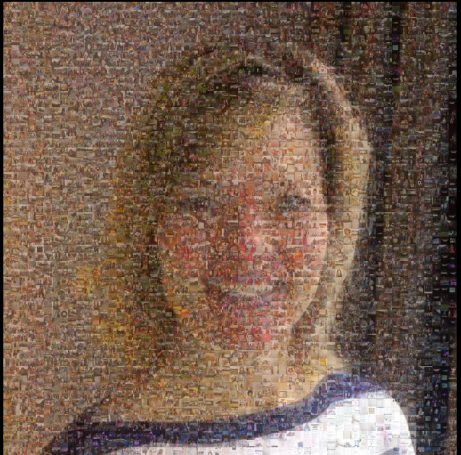
http://mosaically.com/photomosaic/5d4b8db0-be8d-46f6-9a64-4c9b812afdc2
4123 personal pictures from Facebook and my computer were used to create this mosaic.
This is a close up of my smile.
This close up of my smile shows my love for family, friends, food, and fun. These pieces of my identity were not represented in my first #WalkMyWorld selfie. So make sure to ZOOM IN on old friends and challenge them to share the tiny mosaic pieces that have built their identity. At the same time, reach out and make new #WalkMyWorld friends by asking them questions about who they are and where they are going. Click HERE to zoom in on my present identity.

Sunday, January 24, 2016

WEEK ONE OF #WALKMYWORLD 2016

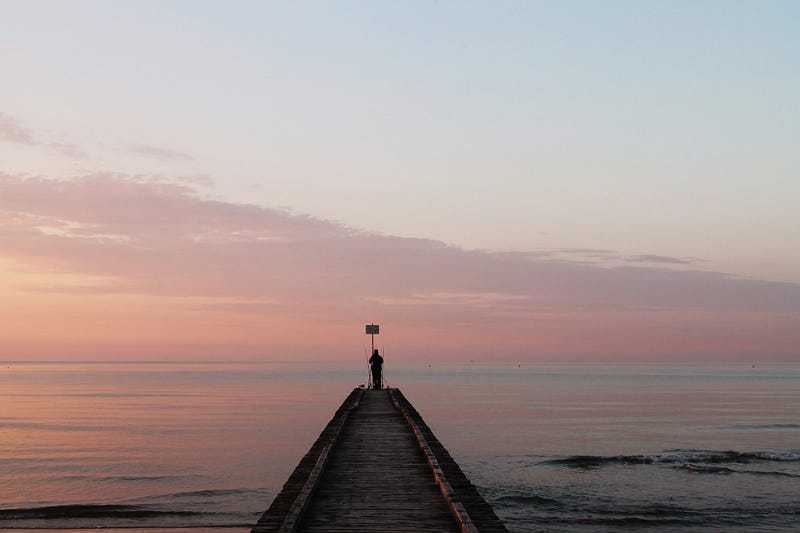
I exist as I am, that is enough, If no other in the world be aware I sit content, And if each and all be aware I sit content — Song of Myself #20, Walt Whitman
Photo by Gae Faro https://flic.kr/p/veJkmh shared under a CC BY license
Did you ever stop and wonder, “Who am I?” Join us as #WalkMyWorld explores our past, present, and future identities through images, words, sounds, gestures, and memories. Over the next ten weeks, we will post a learning event and invite you to share something about the story of your daily “walk” in the “world.” There are no right answers and anyone can join in the exploration. However, we ask that you share at least once a week, publicly on Twitter, by including the hashtag #WalkMyWorld in your post. The hashtag will help us build a community of identity explorers (educators, students, and researchers) from across the world. Let’s get curious about how meaning-making through different modes such as images, words, sounds, and gestures can shape our view of the world.

WEEK ONE: Exploring our identity through visual meaning making
We have heard the saying, “A picture is worth a thousand words,” but is that really true? What does it mean to make meaning using a picture instead of words? Pictures, or visuals, can be broken down into two different groups:
  1. Visuals that are still: Drawings, Paintings, Photographs, and Sculptures
  2. Visuals that are moving: Animation, Video clips, TV, and Film
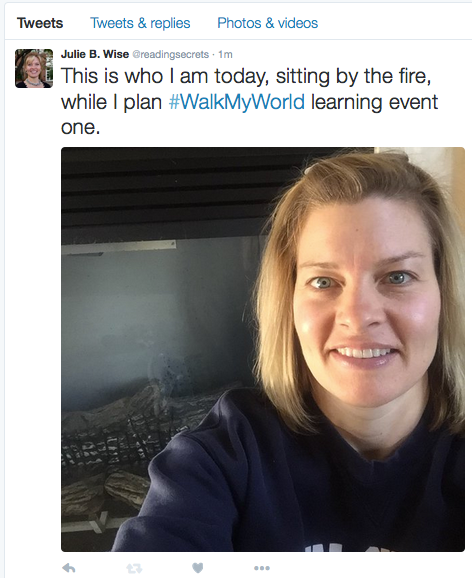
Invitation: Share the story of who you are just for today. You can use any type of visual (s) to explore your present identity. Ask yourself, “Who am I right now?” and then share it on Twitter using the hashtag #WalkMyWorld. For example, you could take a selfie and Tweet it like I did:
Bam, you are finished. That was easy! Maybe you want to draw a self-portrait like these famous artists. Is there a video clip on Youtube or Facebook that has meaning for your present identity? Then copy the URL address and share this content as a link in a tweet. Here is a visual rendition of Eleven by Sandra Cisneros. Notice how the story of an eleven-year-old on her birthday is remixed with moving visuals and words. You might even make meaning through both visuals and words in a blog. For instance, Katarina Silvestri uses the digital tool Mosaically to visually represent her present identity.

It’s time. What will you share? Explore.Make.Play.Learn.

Interested in learning more about #WalkMyWorld, visit: walkmy.world

Tuesday, January 19, 2016

Welcome to the #WalkMyWorld Project 2016

Want to identify ways to supercharge your own social media and blogging skills while identifying ways to embed it in instruction? Come join us in the 2016 iteration of the #WalkMyWorld Project.
Over the past three years we’ve been building and iterating on an open-learning, open-research, and open-publishing educational experience. Around the hashtag (#WalkMyWorld) we’ve been encouraging people to get online, create, share, and connect with others.
You can learn a bit more about the project up to this point by viewing our trailer (1:51). If you’ve got a bit more time, you can watch the complete video overview (19:54) of the project up to this point.

After our last walk

Since our last iteration of the project in 2015, we had a couple more publications and presentations. You can keep track of our research here on this page.
Speaking of pages…we decided to launch a whole new website (http://walkmy.world/). We’re moving over all of the content from the old site and then will shut it all down except for a link to redirect links we included in print publications. The new website has a ton of new features baked in. An example of this is a tweetable summary you’ll find at the top of all of our Learning Events. This will give you a quick overview of what the page will contain.
In the website we also baked in some awesome social features. One of the coolest happens when you highlight a section of text. It’ll provide you with a black toolbar to automatically share out that text and page to some of your favorite social media tools or email. You’ll also get a second toolbar for Hypothes.is. Annotating the web is important to us, and we decided to make it a permanent part of our DNA. Please use Hypothes.is to mark up the page, provide commentary, or connect us to others online.
Finally, the planning and facilitating team is even stronger now as we’ve got a group of new voices working with us. You can get a sneak peek of most of us in planning sessions one (1:09:01) and two (1:00:39) for this year. I’m sure you’ll enjoy getting to know all of them through their posts and tweets.


Starting our current walk

For the #WalkMyWorld Project, we will lead you through 10 Learning Events (LE). For each LE, we’ll list a basic way to read, write, and connect with the community. Please feel free to edit, revise, or hack away at any of the LEs for your own learning and development. The texts, directions, and “assignments” in each learning event are merely starting points. You should find your own entry point for yourself and your learners.
To get us started in 2016, this week is an onboarding week. What that means is that it serves as an alarm to our PLNs to get ready. It also provides everyone with enough time to get their Twitter accounts, social media clients, and blogging tools ready. We’re recommending that you have at least a Twitter account and a website/blog for this project. You are more than welcome to share your work out to networks other than Twitter…but please include the #WalkMyWorld hashtag…and a hashtag indicating the Learning Event you’re working on.
For #LE0 (Learning Event Zero) please review this page on the website. If you have questions or comments about the work for this week…please leave a comment on the page, use the tutorials, or send out tweet out on Twitter using the #WalkMyWorld hashtag.

Let’s get started

We’re looking forward to getting started on this walk together. Basically you should plan on at least one blog post and tweet per week…at the minimum. You’ll have a better sense of what to work on and post/tweet once you read the LE for the week. The LEs will be launched on the project website and on Twitter on Sunday afternoon of each new week.
So…get yourselves ready. Say hi to each other online. And…see you in six days for #LE1. :)

Originally published at W. Ian O’Byrne.

Monday, January 11, 2016

#WalkMyWorld 2016: Past.Present.Future

The best part of #WalkMyWorld is the social scholarship (i.e., community, discussion, and reflection) that occurs. Although teachers talk all day to students, they rarely make the time to talk to colleagues. By keeping #WalkMyWorld open, others may stumble on our discussions and learn, grow, or even join in. If you want to read more about how I created my Personal Learning Network (PLN) from #WalkMyWorld, click HERE.

Should #WalkMyWorld remain open or move to private streaming? 
I keep thinking about where to post #WalkMyWorld information...this answer is vast. In the past, some participants created a new Twitter profile because they didn't want their followers to be a part of their class work or see their students' information. However, some participants didn't like having several different accounts and used the one they had already established. Finally, there were participants who didn't want to post, they wanted to keep everything on paper. So I guess the question is, "What is our purpose for #WalkMyWorld?" Is it to collect data for research, then we should set it up to make the data collection process easy. If our purpose is to teach others how to make meaning from multiple modes through an online learning environment, then we need to use the medium that people will easily share their thinking. Twitter is a platform that is becoming more accessible to educators and classrooms. To me, Twitter is still a valuable medium to share, explore, and play with multimodal meaning-making and digital tools.

As we reflect on the PAST #WalkMyWorld in order to plan for the PRESENT learning events and build a foundation for the FUTURE, I feel the picture below captures the answer. Let's stand in the middle by using Twitter, not only to collaborate and communicate, but to begin to show others about new digital tools like Medium.


How did you get involved in #WalkMyWorld? Did you start as a participant or facilitator? I started out as a participant because I was following Greg McVerry and Ian O'Bryne on Twitter after I met them at an LRA conference. Ian responded to one of my posts and I became more involved. By the end of Learning Event 10,  Ian invited me to help analyze his data. That analysis became a paper, “Social Scholars: Educators Digital Identity Construction in Open, Online Learning Environments," that we presented at the 2014 Literacy Research Association Annual Conference. The paper was recently published in Literacy Research: Theory, Method, and Practice, a peer-reviewed publication of the Literacy Research Association. 

How have you grown as a teacher because of #WalkMyWorld? Each day I participate in #WalkMyWorld, I become a more knowledgeable teacher:  1) technological knowledge - everyone shares new tools or aspects of a tool I didn't know I could use; 2) pedagogical knowledge - I read about how other teachers are creating and managing an online learning environments; 3) content knowledge - I have witnessed lesson plans for incorporating technology in science, social studies, math, and English Language Arts. These knowledge components are also known as technology, pedagogy, and content knowledge (TPACK; Koehler & Mishra, 2009) which provides a framework to understand the domains of knowledge educators should have for authentic technology integration.  
-->

How have your tech skills grown?
My engagement in #WalkMyWorld integrated my theoretical understanding of multimodal composition and my passion for poetry. The #WalkMyWorld community held me accountable for increasing my creativity. At the same time, #WalkMyWorld collaboration gave me support as I tried new techniques and technologies. For example, Kevin Hodgson's interactive poem inspired me to write an interactive poem about the sunrise. Even though Twine was easy to use as a multimodal composition tool, I struggled to embed the poem on the Internet. I used Twitter to contact Kevin for help and we spent several days collaboratively working to solve my technical issues. I also used Twitter to invite the #WalkMyWorld community to write a poem on Goggle Drive. This way I was still involved in the learning event but I shared the responsibility to write a full poem. I was so excited to see how the poem grew and changed as different authors added their voice.  Click HERE if you want to read or write more into the poem.

Interested in other discussions about the planning of #WalkMyWorld 2016? Check out the planning meetings on Google Hangout: Day 1, Day 2 or read the blog posts below:

Kate Booth
Greg McVerry
W. Ian O'Byrne
Carolina Orgnero 
Stephanie Loomis


Monday, February 2, 2015

#WalkMyWorld Learning Event #3: Struggling Doesn't Mean Stupid

Welcome to Learning Event Three in the #WalkMyWorld Project! For this learning event we invite you to reflect on your identity. Do you have one consistent identity (online and offline) or are they different? Does the identity you share publicly represent who you are inside your head?  The facilitators of #WalkMyWorld are challenging you to open up by sharing a piece of your past or your goals for the future. Today I felt like sharing a piece of my past with a picture of me in 5th grade, when I first realized my brain struggled with letters.

Present identity: This is me at an International Literacy Association conference (formally known as the International Reading Association) with my good friend and mentor, Dr. Jerry Johns. I am a third year PhD student, the president of Pennsylvania's Reading Association, and a leader in the field of literacy.


Past identity: This is me as a fifth grader (with my younger brothers). Despite the dimples and the feathered hair, this was the year I was anything but an average 5th grader. For the first time I realize my brain was always going to struggle to process letters when I had to walk down the hall to a 4th grade reading class. I loved school, but no matter how hard I tried, or the hours spent with tutors, my brain still struggled to spell simple words. I also struggled to recall subject-matter content for tests. As a result, I was placed in a lower academic track for middle and high school.

My guidance counselor said I shouldn't waste my time applying to college. My college accepted me on a one year probation after I pleaded in an entrance interview that:

I HAD to become a teacher so I could tell students who struggle with letters that they are brilliant.

I HAD to become a leader in literacy so I could show educators how to look beyond poor spelling.

I HAD to become a researcher so I could find evidence that struggling doesn't mean stupid.

Struggling just means I need more time to process letters. I need technology to spell my words, and I need multimodal opportunities to show my brilliance.

Take some time this week to think about who you are and share your reflections with me at the #WalkMyWorld Project. You can click this link to read more about Learning Event #3: http://wiobyrne.com/walkmyworld-learning-event-three-2015/

Happy reflecting,
Julie

Thursday, January 15, 2015

Let's play on the #WalkMyWorld digital playground!

January and February can be the two most difficult months to teach. The holidays are over, winter weather causes indoor recess, and students are bored with daily literacy routines. The best strategy to chase away the instructional winter blues is to join the #WalkMyWorld project.

The #WalkMyWorld Project is a social media group of educators and researcher who share and connect online at Twitter using one hashtag. Groups of learners across the globe are connecting and sharing for 10 weeks using the #WalkMyWorld hashtag. Don't worry, you don't have to commit to 10 weeks. Stop by any time to connect with other educators, create digital texts, and curate, or organize, all your new ideas. Watch this video to learn how to create a Twitter account.

Connect: #WalkMyWorld allows you to connect with passionate and talented educators from across the globe. Their ideas will inspire you to explore different methods for reading and writing in a digital environment. Each week, go to your Twitter account and search the #WalkMyWorld hashtag for new strategies, tips, and lessons. You can scroll through Twitter posts easily while you are standing in line at the grocery store or during television commercials. I prefer to look at Twitter right before I go to bed at night. When you find an idea you like, begin playing around with the tool. If you have questions, reply to the Tweet, just like you would with an email, and get answers to your questions instantly.

Create: #WalkMyWorld also invites you to create with free, user-friendly digital tools. No need to wait for a school organized professional development day to learn the newest tools. Each week a new tool will be introduced through learning events. The learning events provide an explanation, links to video tutorials, and example texts for which to play. I love how the learning events scaffold the process of creating within digital spaces. They also provide excellent instructional frameworks that you can take and implement easily into your classroom. The learning events begin January 18, 2015, click here to get instant access.

Curate: #WalkMyWorld provides an unique opportunity to learn how to curate, or organize your ideas, work, and discussions that you have in an online social environment. It's easy to get overwhelmed and disorganized in a digital space. At the same time, it's important to begin to think about your digital identity. #WalkMyWorld learning events will show you how to ask the right questions and target important resources to improve your instruction and strengthen your online identity. Click here to learn more about curating.

Turn January and February into the best months to teach by connecting, creating, and curating with the #WalkMyWorld project. Get inspired by clicking here.

Wednesday, March 5, 2014

Reader.Writer.Scholar: Reflections for #WalkMyWorld

Is poetry still relevant in a time when educators prepare students for high-stakes testing in school while students read and write on cell phones, iPads, and laptops out of school? I asked this question during my first semester in graduate school and used the findings to write a blog post for the International Reading Association’s TILE-SIG blog. As I reflect on my experience with the #WalkMyWorld project, I realize I was replicating my first study. Instead of examining the effects multimodal composition had on 5th grade students’ engagement with poetry, I was examining the effects multimodal composition had on ME. Here are my findings.

READER: My engagement in #WalkMyWorld began as a reader. As I scrolled through the Twitter feed, I selected poems by the media that provoked curiosity. I was amazed at the quality of poetry and found myself rereading poems with a critical eye to determine how the author crafted the text or used multiple modes to evoke emotion. In order to improve my ability to write, I used the author rather than the media as the criteria for selecting which poem to read. Eventually, I moved away from my night time routine of reading facebook posts to reading Twitter #WalkMyWorld posts.

WRITER: My engagement as a writer evolved from isolated poems to recursively generating a poem throughout the day. Initially, I took a picture, wrote a poem, posted it to #WalkMyWorld, and then crossed the task off my “to do list.” Now, a word might spark the need to take a picture or a picture might dictate the words. As my involvement in the project increases, I notice a greater sensitivity to the natural world and language that surrounds me. I learned the importance of taking a picture the instant nature sparks my attention. Thinking about my audience motivates me to go back and retake a picture in order to adjust the quality. In the beginning, I generated poems by selecting words from my own schema. Now I collect words and phrases throughout the day by typing them into the notes section in my cell phone. This recursive shift continues to improve the quality of my writing and enjoyment in the composition process.

SCHOLAR: My engagement as a scholar integrated my theoretical understanding of multimodal composition and my passion for poetry. The #WalkMyWorld community held me accountable for increasing my creativity. At the same time, #WalkMyWorld collaboration gave me support as I tried new techniques and technologies. For example, @dogtrax interactive poem inspired me to write an interactive poem about the sunrise. Even though Twine was easy to use as a multimodal composition tool, I struggled to embed the poem on the Internet. I used Twitter to contact @dogtrax for help and we spent several days collaboratively working to solve my technical issues. I also used Twitter to invite the #WalkMyWorld community to write a poem on Goggle Drive. This way I was still involved in the learning event but I shared the responsibility to write a full poem. I was so excited to see how the poem grew and changed as different authors added their voice.  Click HERE if you want to read or write more into the poem.

By breaking down barriers of creating, collaborating, and sharing multimodal poetry the #WalkMyWorld project aligned theory, research, and social media. Today is your chance to make poetry relevant by joining the #WalkMyWorld project. Share your thoughts on how the project enriched your experiences as a reader, writer, and scholar.